

Ecommerce SEO is the process of optimizing an online store so that product pages, category pages, and supporting content rank higher in search engines and — increasingly — get cited in AI-generated answers. The goal is organic traffic that converts into revenue without per-click advertising costs.
In 2026, that definition has expanded. Product pages now compete across three surfaces simultaneously: the traditional organic search results, Google Shopping and merchant listings, and AI Overviews — the AI-generated answer boxes that now appear on roughly 14% of shopping queries, up from just 2.1% in November 2025. Ranking on one surface while being invisible on the others leaves money on the table.
This guide covers every layer of ecommerce SEO as it works today: keyword research, product and category page optimization, site architecture, technical performance, content strategy, link building, structured data, and the new discipline of Generative Engine Optimization (GEO) that determines whether AI systems recommend your products.
How Ecommerce SEO Differs from Regular SEO
Standard website SEO and ecommerce SEO share the same underlying principles — relevance, authority, technical health, user experience. But online stores face a distinct set of challenges that content-only websites don’t encounter.
Scale. A blog might have 200 pages. An ecommerce store can have 50,000 product URLs, thousands of category and filter combinations, and hundreds of variant pages for size, color, and material. Managing SEO across this volume requires systematic processes, not manual page-by-page optimization.
Duplicate content. Products in multiple categories generate duplicate URLs. Manufacturer descriptions shared across retailers create cross-site duplication. Size and color variants often produce near-identical pages. Left unmanaged, these issues dilute crawl budget and confuse search engines about which page to rank.
Thin content. Many product pages have little more than a title, a price, and a manufacturer spec sheet. Search engines struggle to differentiate these pages from thousands of similar ones across the web.
Faceted navigation. Filter menus on category pages — size, color, price range, brand — can generate millions of indexable URL combinations from a few thousand actual products. Google’s Gary Illyes has attributed 50% of reported crawling issues to faceted navigation, with sorting parameters accounting for another 25%.
Transactional intent. Ecommerce keywords often carry strong purchase intent, which means the competition for top positions is fierce and the commercial value of ranking is high.
Understanding these differences shapes every decision you make in ecommerce SEO — from how you structure your site to how you write product descriptions to how you manage your crawl budget.
Keyword Research for Ecommerce
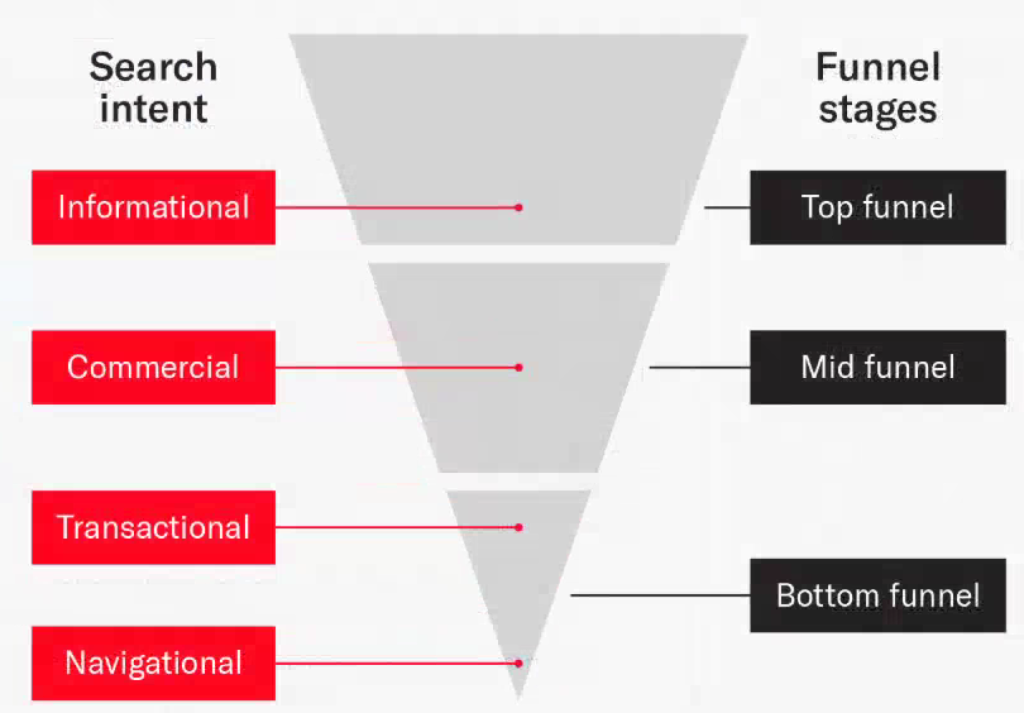
Keyword research for an online store isn’t just about finding high-volume terms. It’s about mapping search intent to the right page type — product pages for transactional queries, category pages for commercial comparison queries, and blog content for informational queries.
Search Intent Categories
Transactional intent — the searcher is ready to buy. Queries like “buy wireless noise-cancelling headphones” or “order organic matcha powder online” signal immediate purchase intent. These should map to product pages with clear pricing and add-to-cart functionality.
Commercial investigation — the searcher is comparing options before buying. Queries like “best running shoes for flat feet” or “top-rated espresso machines under $500” signal research mode. These should map to category pages, comparison guides, or curated collection pages.
Informational intent — the searcher wants to learn something related to your products. Queries like “how to choose a camping tent size” or “difference between French press and pour-over coffee” signal early-stage interest. These should map to blog posts and buying guides that link to relevant product pages.
Navigational intent — the searcher is looking for a specific brand or website. Queries like “Patagonia rain jacket” or “IKEA standing desk” should map to your brand or product pages if you carry those products.
Long-Tail Keywords for Ecommerce
Specific, multi-word queries make up approximately 70% of all search traffic. For ecommerce, long-tail keywords are particularly valuable because they signal clearer purchase intent and face less competition.
“Running shoes” is a broad, highly competitive keyword. “Women’s waterproof trail running shoes wide width” is a long-tail query with far less competition and a much higher conversion likelihood — the searcher knows exactly what they want.
Tools for finding ecommerce keywords include Google Keyword Planner (free, shows volume and competition), Google’s autocomplete and “People Also Ask” suggestions (free, reflects real search behavior), Ahrefs (paid, provides difficulty scores and traffic estimates), and Semrush (paid, includes intent classification for each keyword). When evaluating keywords, focus on three metrics: search volume (demand), keyword difficulty (competition), and commercial value (indicated by CPC data).
Product Page Optimization
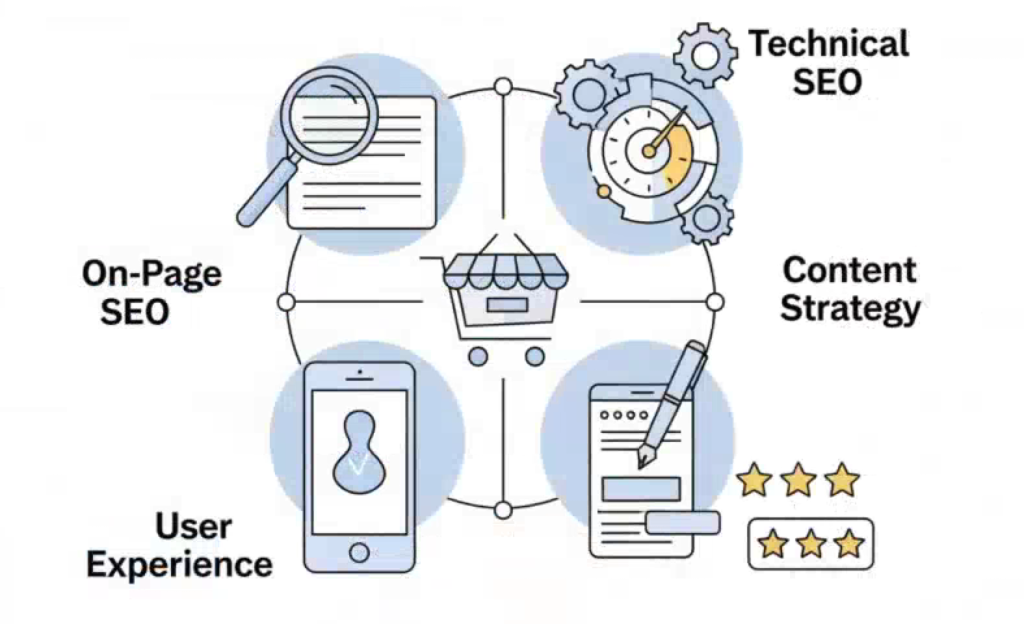
Product pages are where organic traffic converts into revenue. Every element — from the title tag to the image alt text to the structured data — contributes to both ranking and conversion.
Title Tags and Meta Descriptions
The title tag is the single most influential on-page SEO element for product pages. Structure it as: Primary Keyword + Product Name + Key Attribute + Brand. Keep it under 60 characters (roughly 575 pixels) to avoid truncation in search results.
Meta descriptions don’t directly affect rankings, but they determine click-through rate from search results. Write them between 70-155 characters, include a call to action (“Shop now,” “Free shipping”), and mention the most compelling product benefit or offer.
For stores with thousands of products, build templates that auto-generate titles and descriptions from product data fields. For example: “[Product Name] – [Key Feature] | [Brand] | [Store Name]” for titles and “Shop [Product Name] at [Store Name]. [Key Benefit]. [Price] — free shipping on orders over [threshold].” for descriptions. Keep the option to manually override templates for high-priority pages.
Unique Product Descriptions
Copying manufacturer descriptions that appear on dozens of other retailer sites is one of the most common ecommerce SEO mistakes. Search engines can’t differentiate your page from competitors using identical text.
Write unique descriptions that focus on how features benefit the customer rather than just listing specs. A mattress company doesn’t just sell “high-density memory foam” — they sell better sleep for people with back pain. Connect product attributes to customer outcomes.
Include relevant long-tail keywords naturally. Use formatting (subheadings, short paragraphs, bullet points for specs) to make descriptions scannable. Aim for at least 150-300 words of unique content per product page. Higher-value products warrant longer, more detailed descriptions.
Product Images and Alt Text
High-quality product images directly affect conversion rates — 85% of shoppers say product imagery influences their brand selection. The average buyer wants to see multiple images from different angles, not a single photo.
For SEO, every image needs three things: a descriptive filename (red-leather-crossbody-bag.jpg, not IMG_4382.jpg), accurate alt text that describes what the image shows (used by screen readers and search engines), and compressed file size (use WebP or AVIF formats, keep hero images under 200KB) for page speed.
Alt text should describe the image honestly and naturally — “Women’s red leather crossbody bag with gold hardware, front view” is useful. “Best cheap leather bags women buy discount red leather bag” is keyword stuffing and may trigger spam filters.
Customer Reviews on Product Pages
Over 90% of consumers read reviews before purchasing. Reviews help SEO in multiple ways: they add fresh, unique content to pages that would otherwise remain static; they naturally include long-tail keywords in authentic language; they generate social proof that improves conversion rates; and when marked up with AggregateRating schema, they produce star ratings in search results that boost click-through rates.
Ask customers specific questions about their experience rather than requesting generic feedback. Questions like “How does this fit compared to your usual size?” or “What do you primarily use this product for?” generate more detailed, keyword-rich responses.
Category Page Optimization
Category pages are often the highest-value pages for ecommerce SEO because they target broader commercial keywords with higher search volume than individual product pages. A well-optimized “Women’s Running Shoes” category page can rank for dozens of related queries.
Add unique introductory text (150-300 words) above or below the product grid that explains what the category includes, who it’s for, and what differentiates your selection. This gives search engines content to index beyond just product titles and prices.
Use descriptive H1 tags that include the primary keyword. Structure subcategory links logically. Include filter options that help users narrow their selection — but manage the faceted navigation carefully (covered in the technical section below).
Internal linking from category pages to key products, and from blog content back to category pages, builds topical authority and helps distribute link equity to the pages most likely to generate revenue.
Site Architecture and Navigation
How your pages are organized and connected determines both how easily customers find products and how efficiently search engines crawl and index your store.
Flat, Scalable Hierarchy
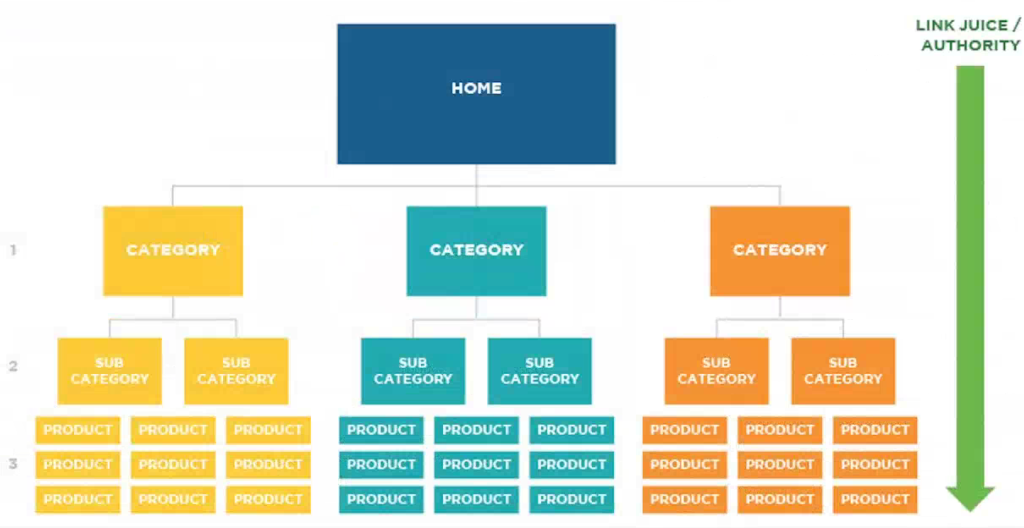
The ideal ecommerce site structure has three levels: Homepage → Categories → Products. Subcategories add a fourth level when needed (Homepage → Categories → Subcategories → Products). Every product page should be reachable within three clicks from the homepage.
This flat structure distributes link equity broadly, makes crawling efficient, and gives users a clear mental model of your store’s organization. Avoid deep hierarchies where products are buried five or six clicks from the homepage — these pages receive less internal link authority and are crawled less frequently.
Breadcrumb Navigation
Breadcrumbs show users their location within your site hierarchy (Home > Women’s Clothing > Dresses > Maxi Dresses). They serve three purposes: users can navigate back to higher-level pages without the browser back button, search engines understand your content hierarchy, and BreadcrumbList schema markup can display your breadcrumb path directly in search results.
Place breadcrumbs at the top of each page, above the main content. Use BreadcrumbList structured data to help Google display them in search results.
URL Structure
URLs should reflect your site hierarchy: example.com/women/running-shoes/nike-pegasus-41. Keep URLs readable, lowercase, hyphenated, and free of unnecessary parameters. Avoid URLs like example.com/product?id=48291&cat=shoes&color=black — these are hard for users to understand and offer no keyword signals.
Technical SEO for Ecommerce
Technical SEO determines whether search engines can access, understand, and index your content. For ecommerce sites with large catalogs, technical issues can silently prevent thousands of pages from appearing in search results.
Managing Faceted Navigation
Faceted navigation is the single biggest technical SEO challenge for ecommerce sites. Size, color, brand, price range, and material filters can multiply a few hundred category pages into millions of indexable URL combinations. Log file analysis consistently shows that 40-60% of Googlebot’s crawl budget on unmanaged ecommerce sites goes to these filter URLs.
Every filter combination falls into one of four categories:
Indexable — filter combinations that match queries with real search volume. “Men’s black running shoes” might have thousands of monthly searches. Create a clean, indexable URL with a unique H1, unique introductory text, and a self-referencing canonical tag. Zalando does this effectively, treating high-demand faceted pages as standalone collection pages.
Canonicalized — filter combinations without meaningful search volume but not harmful. Canonicalize these back to the parent category page so search engines understand the relationship without wasting crawl resources.
Blocked — filter combinations that should never be crawled. Price sorting, rating sorting, and pagination parameters typically fall here. Block them in robots.txt rather than using noindex — noindex still consumes crawl resources because Googlebot must visit the page to find the noindex directive.
AJAX-only — filter results that load dynamically without changing the URL. The most crawl-efficient approach for filters with no SEO value, since no new URL is created for Googlebot to discover.
The decision for each filter combination should be based on search volume data. If “red leather boots size 8” has meaningful search demand, make it indexable. If “boots sorted by price low to high” has none, block it.
Core Web Vitals in 2026
Page speed and interactivity directly affect both rankings and conversion rates. Sites loading in 1 second see conversion rates 2.5 times higher than those taking 5 seconds.
The three Core Web Vitals metrics for 2026:
Largest Contentful Paint (LCP) — measures loading performance. Target: under 2.5 seconds. For product pages, the LCP element is typically the hero product image. Serve it in WebP or AVIF format, use srcset for responsive sizing, and keep file size under 200KB.
Interaction to Next Paint (INP) — replaced First Input Delay (FID) as a Core Web Vital. Measures how quickly the page responds to user interactions. Target: under 200 milliseconds. For ecommerce, the critical interactions are “Add to Cart” buttons, image carousels, and filter menus. Third-party scripts (live chat, analytics, review widgets) are the most common INP killers — defer or lazy-load anything that isn’t critical for initial page interaction.
Cumulative Layout Shift (CLS) — measures visual stability. Target: under 0.1. Product images loading late and pushing content down the page is the most common CLS issue on ecommerce sites. Set explicit width and height attributes on all images to reserve space before they load.
Duplicate Content Management
Use canonical tags to tell search engines which version of a page is the primary one. Common scenarios requiring canonicalization: products accessible through multiple category URLs, HTTP vs. HTTPS versions, www vs. non-www versions, and URL parameters from tracking or sorting.
Set shopping cart pages, internal search results, and wishlist pages to noindex,follow — they have no SEO value but their outbound links still help search engines discover product pages.
XML Sitemaps
Submit XML sitemaps to Google Search Console that list all indexable product, category, and content pages with their canonical URLs and last-modified dates. Segment large sitemaps by content type (products.xml, categories.xml, blog.xml) for easier monitoring in Search Console. Sitemaps are limited to 50,000 URLs or 50MB — use a sitemap index file for larger stores.
IndexNow for Inventory Changes
The IndexNow protocol lets you push URL updates directly to search engines (Bing, Yandex, and data streams feeding ChatGPT) instead of waiting for crawlers to discover changes. For ecommerce sites with frequently changing prices, stock levels, and new products, IndexNow reduces the delay between updating your site and search engines reflecting those changes. Google doesn’t support IndexNow directly but has its own Indexing API for eligible content types.
Content Strategy: Building Topical Authority
Product and category pages target transactional and commercial keywords. But to build the topical authority that lifts your entire site’s rankings, you need informational content that answers the questions shoppers ask before, during, and after purchasing.
The Pillar-Cluster Model for Ecommerce
Organize your content around topic clusters. A pillar page covers a broad topic comprehensively (e.g., “The Complete Guide to Home Espresso”). Cluster articles cover specific subtopics in depth (e.g., “Burr Grinder vs. Blade Grinder,” “How to Dial In Espresso Shot Timing,” “Best Espresso Beans for Milk Drinks”). The pillar links to every cluster article; each cluster article links back to the pillar and to relevant product/category pages.
This interconnected structure builds topical authority — search engines recognize your site as a deep resource on the subject, which benefits the ranking of every page in the cluster, including your commercial pages.
Content Formats That Work for Ecommerce
Buying guides — help shoppers understand what to look for when choosing a product. “How to Choose a Camping Tent: Size, Seasonality, and Weight Explained” targets informational keywords while linking to your tent category page.
Comparison content — addresses commercial investigation queries directly. “French Press vs. Pour Over vs. AeroPress: Which Brewing Method Is Right for You?” positions your store as a knowledgeable authority and links to products in each category.
How-to content — shows product usage and builds trust. “How to Season a Cast Iron Skillet” serves a real user need and links to your cast iron cookware collection.
Trend and seasonal content — captures time-sensitive search demand. “2026 Summer Fashion Trends” or “Best Holiday Gift Ideas for Home Cooks” target high-volume seasonal queries.
Companies with active blogs see 55% more web traffic and 434% more indexed pages. The key is that every piece of content serves a strategic purpose — targeting a specific keyword cluster and linking to specific commercial pages — rather than being published randomly.
User-Generated Content
Customer reviews, Q&A sections, and customer photos add authentic content that search engines value. UGC naturally includes long-tail keywords in real language, generates fresh content on pages that would otherwise remain static, and strengthens E-E-A-T signals (the “Experience” component in particular).
Implement Q&A functionality on product pages where customers can ask questions and receive answers from your team or other customers. This content often matches “People Also Ask” queries in Google and can be marked up with FAQ schema.
E-E-A-T for Ecommerce
Google’s E-E-A-T framework — Experience, Expertise, Authoritativeness, Trustworthiness — determines how credible your site appears to both Google’s quality raters and its ranking algorithms. For ecommerce sites, each component has specific implications.
Experience — Google wants to see evidence that the people behind your content have firsthand experience with the products. Original product photography (not manufacturer stock images), staff-written product reviews, video demonstrations, and “tested by our team” badges all demonstrate real experience. This is the component that separates your product page from a thousand competitors using the same manufacturer description.
Expertise — demonstrate deep knowledge in your product category. Detailed buying guides, technical comparison content, and expert-authored articles build expertise signals. If your store sells hiking gear, content written by experienced hikers carries more weight than generic AI-generated copy.
Authoritativeness — earned through backlinks from relevant industry sites, mentions in media, and consistent brand presence. Category leadership content (original research, trend reports, industry data) builds authority more effectively than thin product descriptions.
Trustworthiness — clear return policies, visible contact information, secure checkout (HTTPS), transparent pricing, and genuine customer reviews all build trust signals. Google’s quality raters specifically evaluate whether a site provides adequate information for financial transactions.
Structured Data and Schema Markup
Schema markup helps search engines understand your content at a granular level and enables rich results — enhanced search listings with star ratings, prices, availability badges, and images that significantly increase click-through rates.
Essential Ecommerce Schema Types
Product schema — the foundation. Include name, description, image, brand, SKU/MPN/GTIN, price, currency, availability, and condition. This data powers Google’s product rich results.
Offer schema — embedded within Product schema. Specifies price, currency, availability, seller, and delivery information. Price and availability must match your landing page exactly — mismatches can trigger disapprovals.
AggregateRating schema — displays star ratings in search results. Include ratingValue, reviewCount, and bestRating. Listings with star ratings consistently see higher click-through rates than those without.
BreadcrumbList schema — displays your site hierarchy in search results. Helps users understand page context before clicking.
FAQ schema — marks up question-and-answer content. While Google now limits FAQ rich results mostly to health and government sites, FAQ schema still helps AI systems extract and cite your content in AI Overviews.
Connected Schema Networks
Individual schema types work better when connected. A Product page should reference its Brand (Organization schema), its BreadcrumbList position, its AggregateRating, and its Offers. This interconnected schema network helps search engines build entity relationships — understanding not just that you sell a product, but what brand it belongs to, how customers rate it, and how it fits within your site’s hierarchy.
Use JSON-LD format (Google’s recommended implementation) rather than Microdata or RDFa. Validate all markup using Google’s Rich Results Test before deploying, and monitor structured data errors in Google Search Console.
Google Merchant Center and Free Product Listings
Beyond standard organic search results, Google offers free product listings through Google Merchant Center. These listings appear in the Shopping tab, Google Search, Google Images, and Google Maps — providing additional organic visibility for your products at no cost.
To participate, upload your product feed to Google Merchant Center with accurate titles, descriptions, images, prices, and availability. The same feed optimization that helps your Shopping ads (clear titles structured as Brand + Product + Key Attributes, high-quality images, accurate pricing) also improves your free listing visibility.
Free listings don’t replace paid Shopping ads, but they provide an additional organic traffic channel that many ecommerce stores underutilize. Monitor performance in the “Performance” tab of Google Merchant Center.
Generative Engine Optimization (GEO) for Ecommerce
GEO is the practice of optimizing your content and brand signals so that AI systems — Google AI Overviews, ChatGPT, Perplexity, Claude — cite, recommend, or summarize your products in their generated responses.
This matters because search behavior is shifting. Around one in five Americans now use AI platforms to search for products. Users ask conversational questions like “What are the best waterproof hiking boots under $200 with good ankle support?” and expect AI-generated recommendations — often without clicking through to any website.
How GEO Differs from Traditional SEO
Traditional SEO earns you a ranking in the list of search results. GEO earns you a mention or citation inside an AI-generated answer. Research from Ahrefs and BrightEdge found that only 17-38% of AI Overview citations come from pages in Google’s top 10 organic results. A page ranking first organically may not appear in the AI Overview displayed above it.
This means GEO requires its own optimization approach on top of traditional SEO fundamentals.
How to Optimize for AI Citation
Structure content for extraction. AI models prefer data formatted in digestible chunks — product specification tables, comparison charts, clear FAQ answers, and concise “product definition boxes” that state what the product is, who it’s for, and what makes it different. Avoid burying key product information in large blocks of unformatted text.
Build entity clarity. AI systems think in entities, not pages. Make sure your brand, products, and categories have consistent names, descriptions, and attributes across your website, Google Merchant Center feed, social profiles, and third-party mentions. Schema markup reinforces entity relationships.
Earn third-party citations. AI models weight mentions from multiple independent sources. Being mentioned in product roundups, industry publications, Reddit discussions, and expert reviews increases the likelihood that AI systems will cite your brand. This overlaps significantly with traditional link building and digital PR.
Create comparison and “best of” content. AI engines frequently draw from content that directly compares products or curates recommendations. Publishing authoritative comparison guides on your own site increases your chance of being the cited source.
Keep product data accurate and real-time. AI Overviews increasingly check price and availability data before recommending products. Ensure your Google Merchant Center feed is updated in near-real-time. As agentic commerce evolves, AI systems will evaluate operational data (stock levels, shipping times, return policies) before making recommendations.
Link Building for Ecommerce
Backlinks from relevant, authoritative websites signal to search engines that your store is a credible source. For ecommerce sites, the most effective link building strategies combine content-driven approaches with product-specific outreach.
Product roundups and gift guides — identify blogs and publications that publish “best of” lists and gift guides in your product categories. Reach out to be included. Some sites require free product samples; others simply need to know you exist. These links are highly relevant because they appear in content that matches commercial search intent.
Guest content on industry publications — contribute genuinely useful articles to publications your target audience reads. The goal isn’t to drop a link — it’s to establish your brand’s expertise while earning a contextual backlink to a supporting resource on your site.
Digital PR and original data — create original research, surveys, or data analyses related to your industry. “We analyzed 10,000 customer orders to find the most popular home office setup” is the kind of content journalists link to because it provides a unique data point they can’t get elsewhere.
Broken link building — find industry resource pages with broken links to products or stores that no longer exist. Offer your relevant page as a replacement. This works particularly well for product categories with high turnover.
Avoid buying links, participating in link exchanges, or using link farms. Google’s algorithms penalize manipulative linking practices, and the short-term ranking benefit isn’t worth the risk of a manual action.
Frequently Asked Questions
How long does ecommerce SEO take to show results?
Most ecommerce sites begin seeing meaningful organic traffic improvements within 3-6 months of implementing a comprehensive SEO strategy. Technical fixes (crawl issues, canonical tags, page speed) often produce the fastest gains. Content and link building compound over 6-12 months. The timeline depends on your site’s current state, competition level, and the resources you invest. SEO is a compounding investment — early results tend to accelerate as domain authority builds.
Do I need a blog for my ecommerce site?
A blog isn’t strictly required, but informational content significantly expands the range of keywords your site can rank for. Product and category pages target transactional and commercial queries. Blog content targets informational queries from people earlier in the buying process — the ones researching before they purchase. Companies with active blogs generate 55% more web traffic. The key is that every blog post should link to relevant product or category pages, creating a path from information to transaction.
How do I handle out-of-stock products from an SEO perspective?
If the product will return to stock, keep the page live with a “notify me when available” option. Don’t delete the URL — it may have backlinks and ranking history you’ll lose permanently. If the product is permanently discontinued, 301 redirect the URL to the most relevant alternative product or category page. Never let discontinued product URLs return 404 errors at scale — this wastes crawl budget and creates dead ends for users arriving from search or backlinks.
Should I use noindex on filtered category pages?
For most filter combinations (price sorting, rating sorting, availability filtering), blocking in robots.txt is more crawl-efficient than noindex. Noindex requires Googlebot to visit the page to discover the directive, which still consumes crawl budget. However, for filter combinations that match queries with real search volume — like “men’s black running shoes” — create indexable pages with unique content and self-referencing canonicals. The decision should be data-driven, based on actual search volume for each filter combination.
How important is mobile optimization for ecommerce SEO?
Critical. Google uses mobile-first indexing, meaning it evaluates the mobile version of your site for ranking purposes. Smartphones drive nearly 80% of retail website visits. Your mobile site needs fast load times (LCP under 2.5 seconds), responsive design that adapts to screen sizes, tap targets large enough for finger navigation, readable text without zooming, and smooth interactivity (INP under 200 milliseconds). A site that works well on desktop but poorly on mobile will underperform in search rankings.
What is the difference between SEO and GEO for ecommerce?
SEO optimizes your pages to rank in traditional search results — the list of blue links. GEO (Generative Engine Optimization) optimizes your content and brand presence to be cited in AI-generated answers — Google AI Overviews, ChatGPT responses, Perplexity recommendations. In 2026, ecommerce sites need both. SEO drives the organic rankings that have been the backbone of ecommerce traffic for two decades. GEO ensures your products are recommended when shoppers use AI tools to research purchases — a behavior that roughly 20% of American shoppers now engage in.






Great breakdown of ecommerce SEO!