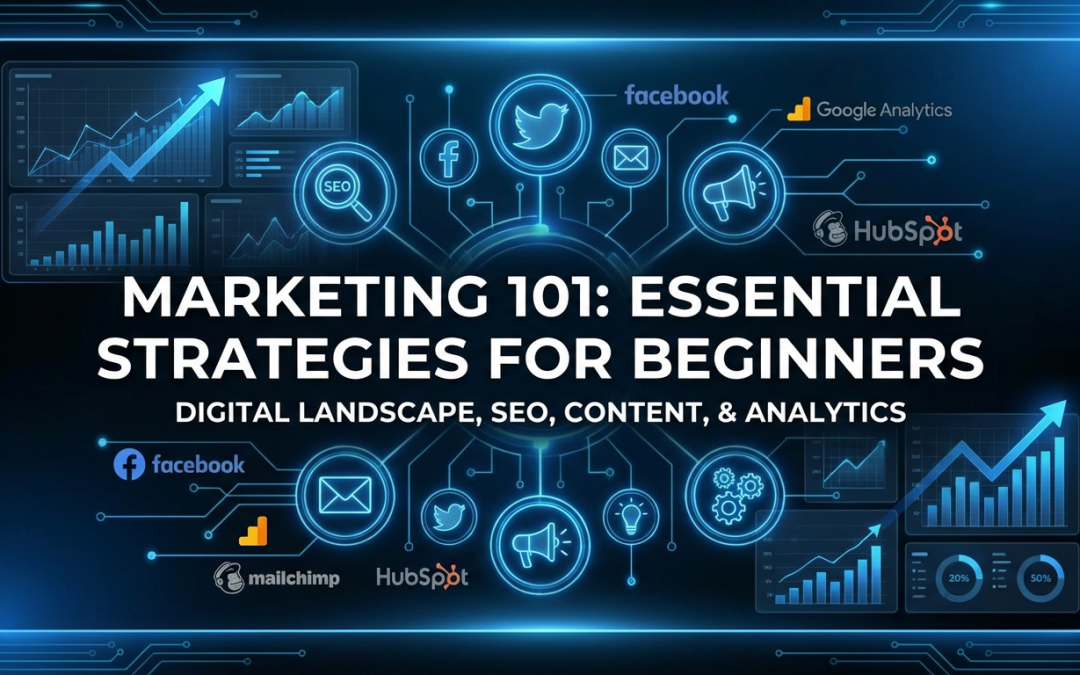
Marketing 101 goes beyond fancy strategies and big budgets—results matter most. Companies that prioritize marketing are 6 times more likely to boost their sales and income. The fundamentals of marketing remain surprisingly simple, whether you start a side hustle or grow your 5-year-old business.
Many beginners feel overwhelmed by complex marketing advice when they just need simple steps to land their first customer. Let’s skip the advanced tactics and focus on marketing fundamentals that drive real results. You can create marketing campaigns that convert browsers into buyers by getting these foundational elements right. The numbers speak for themselves—businesses earn $44 for every dollar they invest in email marketing.
The path to winning your first customer doesn’t require complicated jargon or complex strategies. This piece breaks down the simple marketing basics you need. We’ll explore marketing’s true meaning and build systems that help turn one customer success into many more.
Understand What Marketing Really Means
Marketing is often seen as just clever ads and catchy slogans. But the American Marketing Association defines it as “the activity, set of institutions, and processes for creating, communicating, delivering, and exchanging offerings that have value for customers, clients, partners, and society at large”. This definition shows that marketing is a detailed system, not just a promotional tactic.
Why marketing is more than just advertising
Thinking marketing is only about advertising and sales limits your potential success. Marketing basics go far beyond these visible elements. At its core, marketing is about identifying and meeting customer needs while achieving business goals.
Marketing has several interconnected components:
- Market research to understand customers
- Product development based on customer needs
- Pricing strategy that communicates value
- Distribution planning (where and how customers find you)
- Promotion through various channels
- People and processes that deliver your promises
Marketing focuses on understanding needs, priorities, and behaviors. It orchestrates everything—creating an ecosystem of intent, strategy, culture, and communication that builds resonance and revenue.
The role of marketing in getting your first customer
The trip to your first customer win starts with effective marketing. The customer acquisition process means bringing new customers into your business through a refined sales strategy. Without a steady stream of new customers, growing or even maintaining your current pace becomes challenging.
Marketing guides potential customers through the “acquisition funnel”:
- Awareness: Introducing your brand to capture attention
- Interest: Providing useful information about what you do
- Consideration: Showing how you solve specific problems
- Conversion: Making the purchase process smooth and clear
- Onboarding: Helping customers get started with your product
Marketing acts as the bridge between your business and potential customers. It introduces, educates, and persuades. Above all, it grows your revenue, as every new customer adds to your bottom line and helps increase sales over time.
How marketing connects product and people
The basic contours of marketing rest on three foundational ideas that connect products with people:
Customer orientation forms the foundation of all marketing activities. Every decision, from product design to messaging, should be tailored to customer needs and expectations. This connection isn’t merely transactional—consumers increasingly seek products that help them feel grounded, connected to place, people, and past.
Value exchange stands as another significant element. Effective marketing creates mutual benefit where the business earns revenue or loyalty, while the customer gains a meaningful solution to their problem.
Integrated strategy completes this triad. Success depends on alignment across all marketing elements. When product, price, promotion, people, and process work together, marketing becomes more efficient.
Beyond functional benefits, marketing builds emotional connections. To cite an instance, craft beer accounted for 13.6% of total U.S. volume sales in 2019, growing 4% even while overall beer sales dropped by 2%. This success stemmed from consumers’ desire for products with authentic connections to place and people.
Strong marketing doesn’t simply promote features—it creates a sense of belonging. Research shows that groundedness increases product attractiveness and consumers’ willingness to pay. By understanding these marketing basics, you can create stronger bonds between your product and the people who need it.
Know Your Customer Before You Do Anything Else
A simple truth forms the foundations of successful marketing: you must know your customers before spending money on promotion. Companies waste USD 37.00 billion yearly on ads that fail to reach their target audience. I’ve watched this pattern repeat – new marketers get excited about their product and rush to spread the word. Your marketing efforts become scattered and fail to work without a clear picture of who needs to hear your message.
How to define your target audience
Your target audience represents people most likely to want your product or service. You’ll need to look at traits like age, gender, income, location, and interests to identify this group. Here are practical ways to define your audience:
- Study your existing customer base by perusing demographics, purchasing behavior, and feedback
- Get involved on social media to observe follower interactions and use social listening tools
- Ask current customers through surveys and interviews to gather direct feedback
- Watch your competition to see who they target and how
- Track visitor behavior on your website with analytics tools like Google Analytics
This step is vital because it helps you aim your marketing fundamentals at the right people instead of wasting resources trying to reach everyone. On top of that, it lets you craft messages that speak to specific needs and pain points.
Creating a simple buyer persona
A buyer persona creates a semi-fictional profile that represents your ideal customer based on market research and real data from your existing customers. Picture it as building a character that embodies your target audience’s traits, behaviors, and motivations.
Your effective buyer persona should include these elements:
- Demographics: Age, gender, location, income, education
- Professional information: Job title, industry, responsibilities
- Psychographics: Values, goals, challenges, interests, lifestyle
- Buying behavior: Preferred channels, decision-making process
Companies using buyer personas see 73% higher conversions than those who don’t. This dramatic difference occurs because personas help you understand your customers’ perspective and what drives their decisions.
Keep it simple – start with one or two personas, then refine them as data comes in. Give your persona a name that feels real (like “Marketing Manager Mike” or “Entrepreneur Emma”). The core team can better visualize and understand their target audience this way.
Avoiding the ‘everyone is my customer’ trap
The sort of thing I love seeing new marketers struggle with is believing their product suits “everyone.” This mindset becomes dangerous because your message resonates with no one when you try reaching everyone.
Marketing to everyone weakens your message and drains your budget. Your focus should narrow down to these questions:
- Who would benefit most from your product?
- Who knows how to pay and wants to?
- Where does your product solve a genuine problem?
Your target market shouldn’t be too specific either. An overly narrow focus leaves you with very few leads and prospects. Success comes from finding balance – enough potential customers while maintaining a focused approach.
Note that your target audience should guide marketing decisions while supporting business growth. You can refine your understanding and find new valuable segments as you gather data from early customers.
Craft a Simple Offer That Solves a Real Problem
Marketing gets real when you create an offer—it connects your audience knowledge to your first sale. Your offer must solve a real problem to stand out in a crowded marketplace. Simple products can succeed when they clearly solve specific pain points.
What makes a good offer?
Customers notice compelling offers that contain these key elements:
- Clarity over creativity — Your offer must pass the “blink test” – customers should understand it within 3 seconds. Remove words that don’t make things clearer.
- High perceived value — Customers should see your offer as a bargain while you keep it profitable. Free items work well since a customer’s lifetime value usually exceeds the upfront costs.
- Believability — Nobody responds to offers that seem unrealistic. “Buy one, get one” deals work because customers see them as logical.
- Genuine urgency — Give real reasons to act now, like actual limited stock or data showing delay risks.
- Minimal effort to get — Keep things simple. Nobody likes complicated forms. Test everything on different devices.
Your offer must showcase what sets your product apart from others. Dyson’s vacuum cleaners are a perfect example – they stood out by introducing cyclone technology that solved the problem of clogged filters.
How to arrange your product with customer needs
Understanding your audience’s pain points starts the problem-solving process. Surveys, interviews, and focus groups help you learn about frustrations that drive purchases. This knowledge helps you create offers that really connect with people.
The Value Proposition Canvas helps map customer jobs, pains, and gains. This visual tool shows how your product matches what customers need. You build trust by showing how your product solves specific problems. Trust forms the foundations of marketing fundamentals.
Customer need arrangement comes next—your offerings should match your customer’s priorities and expectations. This approach boosts satisfaction and promotes loyalty. Customers stick with brands that meet their needs consistently.
The “Five Whys” technique improves arrangement. Start with customer feedback, then ask “why” five times to find why it happens. This reveals deeper problems your offer can fix.
Examples of beginner-friendly offers
New marketers find success with these proven offers:
Free valuable resource — Dentists who offer free teeth whitening or chiropractors with free massages (worth $260) get great responses because customers see high value at no cost.
Limited-time promotions — Philips Media boosted their digital video platform by offering free chocolates with Forrest Gump purchases. They added an expiration date to push quick decisions.
Free trial period — Services benefit from this approach. Customers experience the value before spending money, which reduces their risk.
Buy one, get one (BOGO) — These offers succeed because they make sense and show clear value. Extra items at no extra cost are hard to resist.
Entry-level product at reduced price — This “tripwire” approach uses lower-priced items to welcome customers before offering premium products.
Solving real problems remains the key principle in all these examples. Fleetwood Homes proved this by including a home entertainment package with their houses. Their target customers had limited spare money, which made electronic additions very attractive. This simple match between offer and need tripled their sales quotas.
Pick the Right Channel to Reach Your First Customer
With your customer defined and offer crafted, the next marketing question becomes critical: where will you find your first customer? The channel you choose can make the difference between rapid success and wasted effort. The right channel puts your message directly in front of people ready to buy.
Overview of low-cost marketing channels
The good news for beginners is that many effective marketing channels don’t require a big investment. Some of the most powerful options cost little beyond your time and creativity:
- Social media marketing – Platforms like Facebook, Instagram, and TikTok offer both free organic opportunities and targeted paid ads starting at minimal budgets.
- Email marketing – Still considered “king” with an astounding $36 return for every $1 spent.
- Word-of-mouth – Offline conversations remain surprisingly powerful and often more persuasive than online equivalents.
- Online communities – Forums and groups related to your industry provide opportunities for genuine connection.
- Content creation – Blogs, podcasts, and videos that educate your audience establish expertise.
The fundamental marketing principle here is focus over fragmentation. A concentrated approach on one or two key channels consistently outperforms scattered efforts across many. For small businesses with tight budgets, this focused approach stretches marketing dollars effectively.
How to choose based on where your audience is
The best-performing channels aren’t necessarily the trendiest—they’re simply where your audience already spends time. Confirm which platforms your target customers frequent and what content formats they respond to, whether that’s short-form video, newsletters, or long-form education.
Channel selection should follow these principles:
- Define channel purpose – Every channel should serve a specific role in your marketing fundamentals, whether building awareness, driving acquisition, or nurturing retention.
- Analyze competitor presence – Look for channels where competitors are not dominant, as these often yield better ROI and creative opportunities.
- Match channel to customer journey – Different channels work better at different stages of the purchasing process.
- Consider required resources – Assess whether you have the skills (copywriting, design, analysis) to manage the channel effectively.
Choosing channels without strategy leads to wasted resources. Most successful digital marketing strategies use multiple channels in ways that complement each other. For example, social media builds brand awareness and encourages email list sign-ups.
Social media vs. email vs. word-of-mouth
Each of these popular channels offers distinct advantages within your marketing basics toolkit:
Social media has massive reach with billions of monthly active users across multiple platforms, making it excellent for building brand awareness. Its inexpensive entry point makes social media available for businesses of all sizes. Social media excels at introducing people to new brands they might enjoy.
Email marketing, on balance, delivers more direct results. It typically has a higher conversion rate and greater ROI than social media marketing. Email allows for targeted and personalized communication with customers, increasing conversion likelihood. People expect to receive promotional material in email for which they’ve subscribed.
Word-of-mouth, despite being overlooked in many marketing plans, remains incredibly effective. Research shows that 50% of consumers are very likely to make a purchase decision based on a real-life conversation. Word-of-mouth isn’t just happening online—half of all word-of-mouth takes place offline, and these offline conversations are often more persuasive.
The ideal approach isn’t choosing one channel exclusively but integrating multiple channels into a cohesive marketing strategy. For instance, a local bakery might run targeted Instagram ads while offering samples at a weekend farmers’ market—the online ads create awareness while in-person interaction builds trust.
The basic marketing fundamentals here center on channel efficiency. By tracking metrics like Customer Acquisition Cost (CAC) for each channel, you can identify which ones deliver the best returns. Marketing success comes from being where your customers are, with a message they want to hear.
Create a Message That Gets Attention
Your brilliant offer means nothing if your message fails to grab attention. You have mere seconds to capture interest in today’s information-saturated world—studies show 80% of people read headlines, but only 20% continue reading the content. The message you craft becomes your gateway to that first customer win.
Simple ways to write a clear value proposition
A value proposition is a vital statement that explains why customers should choose your product over others. The “We help (X) do (Y) by doing (Z)” formula helps crystallize your unique benefit. A good value proposition answers three key questions about your brand: “Why me? Why my product? And why now?”
To craft a compelling value proposition:
- Focus on clarity over cleverness – Direct statements consistently outperform clever puns or complex wordplay
- Speak directly to customer needs – Address what your audience truly cares about
- Show what makes you different – Highlight your unique benefits compared to competitors
- Write at an 8th-grade reading level – Make it available by avoiding jargon and complex terminology
Note that potential customers care about one thing: what’s in it for them. Put every sentence under the “so what?” microscope. If it doesn’t clearly show value to the reader, revise or remove it.
How to write headlines that make people stop
Headlines create the first impression of your marketing message. They also affect your search engine visibility by a lot since search engines give more weight to words used in headlines.
Effective headlines share these common characteristics:
- Use active voice – Keep your prose punchy and direct (“I threw the ball” vs. “The ball was thrown by me”)
- Stay short and snappy – Headlines should rarely break onto a second line
- Incorporate numerals – They break text monotony and set clear expectations, with odd numbers standing out more
- Add trigger words – Terms like “what,” “why,” “how,” and “when” spark curiosity
- Create urgency – Give authentic reasons why customers should act immediately
Picture the “Late to Work” mindset when crafting headlines: Your dream client is driving, late for work. What single sentence would make them pull over and beg to hear more?
Using emotion and clarity to connect
Emotional appeal creates the foundation of effective marketing messages. You win the heart first, and the mind will create logic to justify what the heart has already decided.
To create emotional resonance:
- Tap into deeper emotional drivers – Look beyond surface feelings like frustration to deeper emotions such as shame (“Why can’t I figure this out?”) or relief (“Thank God someone finally gets it”)
- Describe moments, don’t name emotions – Instead of saying “You’re overwhelmed,” write “You’re doing all your marketing yourself. Posting, emailing, tweaking your website and somehow still feel behind”
- Connect emotion to motivation – Link the feeling to action by showing the path forward
- Balance functional and emotional elements – The most successful marketing blends both rational benefits and emotional appeal
Marketing fundamentals need a balance of clarity with emotional impact. Your message should be easy to understand while triggering an emotional response that motivates action. Weather reports can tell you “it’s cold” or make you feel the cold air stinging when you breathe in. Your marketing message should make customers feel something, not just inform them.
Launch Your First Campaign Without Overthinking It
Your marketing plan needs to spring into action now. Many beginners get caught in endless preparation, but action creates results faster than perfectionism. You just need decisiveness and a willingness to learn through experience to take your first marketing step—not complex systems or big budgets.
What a ‘minimum viable campaign’ looks like
Minimum Viable Marketing (MVM) applies lean startup principles to your promotional efforts. This approach treats campaigns like products and focuses on simple elements that drive learning and improvement. A minimum viable campaign has:
- A single, clear objective (like generating leads or promoting a new product)
- One main marketing channel where your target audience spends time
- A compelling message that speaks directly to customer needs
- A simple way to track results
- A small budget (often just a few hundred dollars) to test concepts
This quickest way helps you spot potential risks and areas to improve before you commit substantial resources. A CPG startup tested different packaging designs through small Facebook and YouTube ad campaigns. They spent just a few hundred dollars before finding a design that struck a chord with Walmart customers.
How to set up your first post, email, or ad
Your first campaign needs to focus on these practical elements:
Start with content that follows the inverted pyramid model. Your key message should come first, supported by visuals and a clear call-to-action button. Adults have an average attention span of only eight seconds, so keep emails brief with scannable text.
You should segment your email audience into small groups to learn which messages get more opens and clicks. Social media campaigns work best when you test different keywords or ad texts with limited budgets to see what drives more conversions.
Keep in mind that your first campaign serves two clients: your target audience and your company. Think of it as an experiment rather than a guaranteed win.
Tracking basic results without fancy tools
You don’t need expensive software or complex dashboards to measure success. Here’s what to do:
- Define what success means specifically for your campaign—more inquiries, sales, subscribers, or repeat customers
- Track actions instead of vanity metrics like likes or views—focus on form submissions, email signups, or purchases
- Ask new customers directly how they found you—this reveals more than any tool
- Use UTM parameters in your links to identify which marketing efforts worked
- Track these basics in a simple spreadsheet to spot patterns over time
Your results become unclear when you change multiple campaign elements at once. Make small adjustments, watch what happens, and use what you learn to improve your next campaign.
Learn From What Happens Next
The real learning starts after your marketing campaign goes live. Your first customer win is a great way to get data that shapes your future marketing fundamentals. Smart marketers don’t just launch and hope—they watch, measure, and optimize based on actual results.
What to look for after launch
Right after launching your campaign, track these key performance indicators:
- Sales and revenue trends – Often the most direct indicators of a product launch’s success
- Click-through and conversion rates – These reveal how your message resonates with your audience
- Customer engagement – Track how users interact with your content and product
- Traffic sources – Identify which channels bring quality visitors versus casual browsers
Unexpected patterns deserve your attention too. High traffic with few conversions might mean your message works but your offer needs work. Similarly, abandoned shopping carts point to possible friction points in your checkout process.
How to ask for feedback from early users
Early customer feedback is gold for marketing 101 success. You should set up multiple channels to gather insights:
Start by adding simple in-app feedback tools or widgets that let users share thoughts while using your product. Next, send short, focused surveys using simple tools like Google Forms—keep questions specific so new customers don’t feel overwhelmed. You can also schedule direct interviews with early adopters who provide deeper context about their experience.
Your brand’s social conversations need monitoring too. Did your launch spark unexpected reactions? The core team might be getting specific questions or concerns. These signals often show which marketing basics need attention.
Making small changes based on real data
Data collection should lead to targeted adjustments:
Patterns in the data should guide your changes. Many users mentioning navigation issues means you should prioritize interface improvements. Content that performs exceptionally well signals an opportunity to create similar material quickly.
Marketing fundamentals include testing variations through A/B testing—changing one element at a time shows what optimizes results. This methodical approach helps you avoid changing multiple factors at once, which makes it impossible to identify what caused the results.
Note that even disappointing launches teach valuable lessons. Each campaign reveals something about your audience, product positioning, and market conditions—making your next marketing effort stronger.
Build on Your First Win With Simple Systems
A business needs more than just that first customer win to build lasting success through simplified processes. Simple systems that you apply consistently work better than complex strategies for sustainable growth.
Why consistency beats complexity
Smart brands know that consistency builds recognition and trust. Research by Lucidpress reveals that a consistent brand presence across platforms can boost revenue up to 23%. Being consistent doesn’t mean being rigid – you just need to be intentional and recognizable with your marketing 101 fundamentals.
Your brand’s consistency across touchpoints shows professionalism and reduces customer confusion. A consistent approach builds emotional connections that promote customer loyalty better than occasional brilliant campaigns, even with limited resources.
How to turn one customer into three
The foundation of any solid marketing strategy transforms current clients into brand ambassadors. Here are the marketing basics you need:
- Set up referral programs that reward customers who bring friends
- Gather and showcase testimonials that resonate with potential customers
- Create post-purchase processes to identify advocates for VIP treatment
Customer testimonials motivate new buyers more effectively than any content you write yourself. Your marketing fundamentals should include ways to collect and share these powerful endorsements.
Using basic marketing tools to stay organized
The right integrated tools save time and deliver results. Your first 90 days should focus on the essentials: claim your Google Business Profile (weeks 1-2), launch a basic website (weeks 2-4), set up email collection (weeks 4-6), establish social media presence (weeks 6-8), and begin content creation (weeks 8-12).
Tools like MailChimp (for up to 2,000 subscribers) and Buffer (for scheduling social posts) give you powerful features without complexity. Marketing automation tools cut down manual work so you can create influential campaigns.
Conclusion
Marketing success doesn’t need complex strategies or huge budgets. In this piece, we’ve cut through the noise to show what actually works to win your first customer. Marketing is more than just advertising—it’s a complete system that connects your product with people who need it.
Success starts when you know exactly who your customers are. A clear picture of your audience helps create targeted messages instead of wasting resources on random approaches. This makes it easier to craft a simple offer that solves real problems.
Without doubt, picking the right channel makes all the difference. You must meet your customers where they spend time, whether it’s social media, email, or word-of-mouth. Your message needs to connect emotionally and show clear value to stand out.
Many beginners get stuck trying to make everything perfect. Taking action gets results faster than endless planning. Start with a basic campaign, learn from the results, and adjust. Even setbacks teach valuable lessons for your next marketing push.
Long-term success comes from turning that first win into a system you can repeat. Simple beats complex every time. Basic tools and well-planned processes help turn one customer into three through referrals and testimonials.
These marketing basics work because they connect real solutions with real people. Take your first step today, track what happens, and build from there. Your first customer isn’t just a sale—it’s the start of your marketing future.
FAQs
Q1. What are the key elements of a successful marketing strategy for beginners? A successful marketing strategy for beginners includes understanding your target audience, crafting a clear value proposition, choosing the right marketing channels, creating compelling messages, and consistently measuring and adjusting your efforts based on results.
Q2. How can I identify my target audience effectively? To identify your target audience, analyze your existing customer base, engage on social media, conduct surveys, study your competition, and use analytics tools. Create buyer personas that represent your ideal customers, including demographics, professional information, and buying behaviors.
Q3. What’s the best way to create a compelling offer for potential customers? A compelling offer should solve a real problem, have high perceived value, be believable, create genuine urgency, and require minimal effort to obtain. Focus on clarity over creativity and align your product with specific customer needs.
Q4. Which marketing channels are most effective for small businesses with limited budgets? Low-cost, effective marketing channels for small businesses include social media marketing, email marketing, word-of-mouth referrals, online communities, and content creation (blogs, podcasts, videos). Focus on one or two channels where your target audience is most active.
Q5. How can I measure the success of my first marketing campaign without expensive tools? To measure your first campaign’s success, define specific goals (e.g., inquiries, sales, subscribers), track actions rather than vanity metrics, ask new customers how they found you, use UTM parameters in links, and create a simple spreadsheet to monitor basic metrics and identify patterns over time.