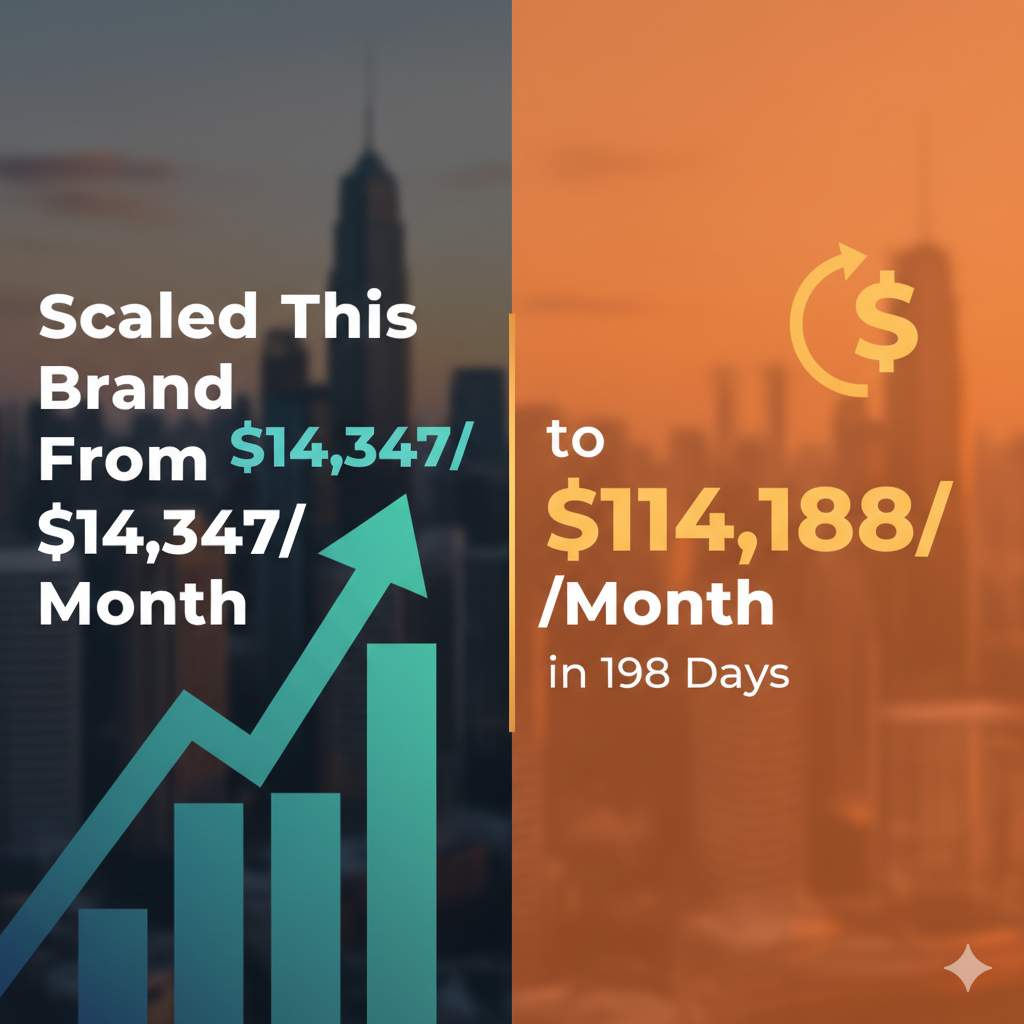
Google Ads Case Study: How Tupa Scaled This Brand From $14,347/Month to $114,188/Month in 198 Days

The Challenge: Untapped Potential
When this e-commerce brand approached Tupa in mid-October 2023, they were generating $14,347 per month through Google Ads with a 214% ROAS. Decent results, but we knew there was massive room for growth.
Our mission: Scale revenue while maintaining (or improving) profitability.
The Results: 8x Revenue Growth in Under 7 Months
Tupa team had transformed this account:
- Revenue increased from $14,347/month to $114,188/month (696% growth)
- ROAS improved from 214% to 239% (despite massive scale)
- CPA decreased from $31.24 to $28.15 (more efficient acquisition)
- Branded conversion dependency dropped from 49% to 31% (healthier traffic mix)
Let us walk you through exactly how the Tupa team made it happen.
The Strategy
Phase 1: The Tupa Account Audit
At Tupa, every engagement begins with a comprehensive account audit. We don’t make assumptions—we dig into the data to understand what’s working, what’s broken, and where the opportunities lie.
Our 5-Point E-Commerce Audit Framework:
- Conversion Tracking
- Audiences
- Product Feed
- Product Performance
- Account Structure
What We Found: Critical Issues Holding This Account Back
1. Conversion Tracking Problems
The Tupa team immediately identified serious tracking issues:
- Duplicate conversion tags were inflating conversion numbers (two ‘Purchase’ tags installed via different Google Tag Manager accounts)
- No enhanced conversions were being captured
- Data integrity was compromised, making optimization decisions unreliable
The Tupa Solution:
- Migrated all conversion tracking to Shopify’s native integration
- Eliminated duplicate tags
- Enabled enhanced conversions for better attribution and audience building
Tupa insight: Clean data is the foundation of everything. If your tracking is broken, every optimization decision you make will be based on faulty information.
2. Audience Setup: Massive Missed Opportunities
Many advertisers think audiences are only for remarketing. At Tupa, we know better.
What was missing:
- No customer list integration
- No audience signals for Performance Max campaigns
- Dynamic remarketing parameters weren’t being captured
The Tupa Solution:
- Connected Klaviyo to Google Ads with daily auto-sync of customer lists
- Implemented these audiences as signals in Performance Max campaigns
- Fixed Google Tag implementation to capture dynamic event parameters for remarketing
These audiences became crucial for:
- Providing optimization signals to Google’s smart bidding algorithms
- Creating lookalike audiences for prospecting
- Powering highly effective remarketing campaigns
3. Product Feed: The Foundation Was Cracked
At Tupa, we believe the product feed is the single most important element of e-commerce Google Ads success. This account’s feed had serious problems:
Issues we uncovered:
- Multiple disapproved products
- Duplicate product listings
- Products missing reviews
- Poorly optimized titles (just product names, no attributes)
- No custom labels for organization
- Sale prices not reflected in the feed (missing the ‘sale’ tag opportunity)
The Tupa Solution:
Within one week, our team:
- Fixed all disapproved products to maximize inventory availability
- Created 3 strategic custom labels:
- Custom Label 1: Product collections
- Custom Label 2: Selling rates (top/mid/low sellers)
- Custom Label 3: Price ranges (under $30, $30-$60, $60-$90, $90+)
- Restructured all product titles using our proven formula:
[Product Name] – [Size] + [Material] + [Collection] + [Brand Name] - Added sale_price attributes to showcase promotions directly in ads
These changes immediately improved ad relevance, Quality Scores, and click-through rates across Shopping and Performance Max campaigns.
4. Product Performance Analysis: The 80/20 Rule in Action
The Tupa team’s analysis revealed a classic Pareto distribution:
- One product category generated 50% of all sales but only received 20% of ad spend
- One specific collection drove 30% of sales at highly profitable rates
- Budget allocation was completely misaligned with performance
The Tupa Strategy:
We created a data-driven budget allocation plan using our custom labels to:
- Aggressively increase spend on top-performing categories
- Segment campaigns by performance tier
- Enable granular optimization and reporting
5. Account Structure: Starting From Scratch
With clean data, optimized feeds, and strategic custom labels in place, the Tupa team built a new account structure from the ground up.
Phase 2: Building The Foundation (The Tupa Core Campaign Framework)
At Tupa, we believe every e-commerce account needs three core campaigns to target the entire buyer journey:
Campaign 1: Standard Shopping (Cold Traffic)
Purpose: New customer acquisition across all products except top sellers
Why Standard Shopping still matters:
- Better at acquiring genuinely new customers
- Provides more transparent search term data
- Less remarketing-focused than Performance Max
- Works synergistically alongside Performance Max
Our approach: We organized products into category-based ad groups for granular control and optimization.
Campaign 2: Performance Max for Top Sellers (Full Funnel)
Purpose: Maximize revenue from proven winners
This was a game-changer. By isolating the product category that generated 50% of sales into its own Performance Max campaign, we were able to:
- Dramatically increase budget allocation to proven performers
- Improve conversion rates by focusing on winners
- Lower CPA through better conversion rates
- Leverage Performance Max’s full-funnel targeting across all Google properties
Tupa insight: This single strategic decision was one of the biggest drivers of the account’s transformation.
Campaign 3: Branded Search (Hot Traffic)
Purpose: Protect brand equity and capture high-intent searchers
This client operated in a hyper-competitive niche with 7+ direct competitors. We needed to:
- Defend against competitor conquest campaigns
- Capture existing brand awareness at the lowest possible cost
- Maintain control over our brand messaging
Phase 3: The Tupa Optimization Process
Launching campaigns is just the beginning. At Tupa, we have a systematic optimization process focused on five key areas:
1. Bid Strategy Optimization
The Tupa approach to bidding:
We don’t rush into aggressive Target ROAS strategies. Instead:
- We wait until campaigns have 25-50 conversions in 30 days (enough data for smart bidding)
- We start with conservative Target ROAS (250% when historical data showed 300%)
- We gradually increase targets over weeks (eventually reaching 320% ROAS)
This patient approach prevents performance drops from overly restrictive bidding.
2. Negative Keyword Architecture
The Tupa team created comprehensive shared negative keyword lists:
- Brand terms (for non-brand campaigns)
- Always Exclude (free, quiz, DIY, etc.)
- Competitors
- Careers & Jobs
- Adult content
- Deals & Coupons
- Education terms
- Websites & Domains
- Travel & Real Estate
- Other irrelevant terms
Tupa insight: Many of these can be added proactively without waiting for wasted spend. Don’t wait to see “free” in your search terms report—exclude it from day one.
3. Product Exclusions
Once campaigns gathered sufficient data, we ruthlessly excluded underperformers:
Our rule: If a product spent 3-5x our target CPA without converting, we excluded it.
This ensured budget flowed exclusively to profitable products.
4. Performance Max Asset Optimization
Even in automated campaigns, the Tupa team continuously optimizes:
- Remove poor-performing assets (Google labels them for us)
- Rotate in fresh creative regularly
- Test different asset combinations systematically
5. Asset Group Strategy
This is where Tupa’s Performance Max expertise really shines. We optimized asset groups through:
A. Feed-Only vs. Full-Build Testing
We tested removing all assets except the product feed (no images, videos, or copy in the asset group). In several tests, feed-only asset groups significantly outperformed full-build versions.
B. Audience-Specific Asset Groups
When we identified “Interior Design & Decorating Services” as a high-performing audience segment, we created dedicated asset groups with tailored imagery and messaging for that audience.
C. Continuous Creative Refresh
We regularly added new images and videos based on performance trends, leading to measurable improvements in conversion rates.
Phase 4: Scaling to $114K/Month (The Tupa Growth Framework)
With optimized foundations in place, we executed our scaling strategy across three dimensions:
Horizontal Scaling: New Markets
We replicated our best-performing campaigns into Canada and the UK, starting with:
- Branded campaigns (lowest risk)
- Then expanding to Performance Max (once we validated market demand)
Horizontal Scaling: New Campaign Types
1. Dynamic Search Ads (DSA)
- Captured search terms we might have missed
- Targeted all product collections automatically
- Expanded keyword coverage higher in the funnel
2. Non-Brand Exact Match Search
- Focused exclusively on proven top-performers
- Gave us more control over high-value keywords
3. Additional Performance Max Campaigns
- Created separate campaigns for other high-performing categories and collections
- Several achieved 300%+ ROAS within weeks
- Became critical scaling vehicles
Vertical Scaling: Budget Increases
The Tupa approach to budget scaling is methodical:
- 15-20% increases every 3-4 days on top performers
- Never rushing (which can destabilize performance)
- Constant monitoring of efficiency metrics
This patient, data-driven approach allowed us to 8x revenue while actually improving ROAS.
The Tupa Difference: Why This Worked
This wasn’t luck. This was systematic, expert execution across every dimension of Google Ads management:
✅ Clean, accurate tracking as the foundation
✅ Strategic feed optimization to maximize ad relevance
✅ Data-driven budget allocation to proven winners
✅ Continuous testing and optimization across all campaign elements
✅ Methodical scaling that maintained profitability
%
↑ ROAS
%
↓ CPA
Revenue
%
↑ Conversion Value
More Successful Projects

Design Agency
Curabitur placerat leo leo, id ultrices
Corporate Landing
Curabitur placerat leo leo, id ultrices
Non-Profit Website
Curabitur placerat leo leo, id ultrices