How to Write High-Converting Google Ads: The Complete Guide
Google controls roughly 90% of the global search engine market. For most businesses running paid search, the difference between profitable campaigns and wasted spend comes down to what you write in your ads.
Not your budget. Not your bidding strategy. Your words.
The average search ad CTR across industries sits between 3.5% and 6.1%, with top performers hitting double digits. A Quality Score of 10 can cut your cost per click in half compared to an account-level average of 5. And with Google now showing per-asset click and conversion data for RSA headlines — replacing the vague “Good” and “Best” labels — advertisers finally have the granular data to know exactly which headlines pull their weight and which ones drag performance down.
This guide covers every layer of writing Google Ads that convert, from headline mechanics and RSA asset strategy to description copy, testing frameworks, and the AI-driven features reshaping how ads get assembled. Whether you’re launching your first campaign or managing six figures in monthly spend, the principles here will help you write ads that do more than show up — they earn clicks from the right people and turn those clicks into revenue.
Why Your Headlines Carry More Weight Than You Think
Your headline is the first — and often the only — thing a searcher reads before deciding whether to click. In a Google search results page crowded with organic listings, AI Overviews, Shopping ads, and competing text ads, your headline has to earn attention in under two seconds.
Headlines Drive Your Most Important Metrics
CTR is the clearest signal of whether your headline is doing its job. A strong headline can double or triple your click-through rate on the same keyword, at the same bid, in the same position. And because CTR directly feeds into Expected CTR — one of the three pillars of Quality Score — your headline quality ripples through your entire cost structure.
A higher Quality Score means a lower CPC for the same ad position. Google’s own data confirms that advertisers who improve their Ad Strength from “Poor” to “Excellent” see an average 15% increase in clicks and conversions. Ad Strength isn’t a perfect proxy for performance, but it’s a useful signal for whether your headline set has enough variety, relevance, and keyword coverage.
The three Quality Score components and how headlines affect each:
- Expected CTR — Google predicts how likely users are to click your ad based on historical performance. Headlines that match search intent and include relevant keywords tend to lift this score.
- Ad Relevance — How closely your ad matches the meaning behind the search query. A headline that addresses the user’s specific need (“Emergency Plumber in Denver”) beats a generic one (“Professional Plumbing Services”) every time.
- Landing Page Experience — Your headline sets an expectation. If your ad promises “Free 14-Day Trial” but the landing page leads with a pricing table, bounce rates climb and Quality Score drops.
A Quality Score of 8 can mean paying half the CPC of a competitor with a Quality Score of 4 — for the exact same keyword. That’s not a marginal advantage. Over thousands of clicks, it fundamentally changes your unit economics.
The Headline-to-Landing-Page Chain
Your headline creates a promise. Your landing page has to keep it.
This alignment — often called “message matching” — is one of the most underappreciated factors in conversion rate optimization. When someone searches “emergency plumber near me” and clicks an ad that says “Same-Day Emergency Plumbing in Denver,” they expect to land on a page about emergency plumbing in Denver. If the page opens with “Welcome to Johnson Plumbing — Serving Colorado Since 1998,” you’ve already lost them. They’re back on Google clicking your competitor’s ad.
Mobile makes this even more critical. Studies consistently show that a one-second delay in mobile page load time can reduce conversions by 20%. The faster and more seamless the transition from headline promise to landing page delivery, the more conversions you’ll capture.
For every major ad group or campaign theme, audit the connection between your headline, your description, and the H1 of your landing page. They should feel like one continuous conversation, not three separate messages written by three different people.
How Responsive Search Ads Actually Work (and Why It Changes How You Write)
If you’re still thinking about Google Ads copy the way you did with Expanded Text Ads, you’re writing for a format that no longer exists. Since Google fully retired ETAs, Responsive Search Ads are the only standard search ad format. Understanding how RSAs assemble your copy is the foundation of writing ads that perform.
The Assembly System
Each RSA holds up to 15 headlines (30 characters each) and 4 descriptions (90 characters each). At auction time, Google’s system selects up to three headlines and up to two descriptions from your pool, assembles them into a single ad, and serves the combination it predicts will perform best for that specific query and user context.

The order of headlines can also vary unless you pin them. This means a user searching “emergency electrician Sydney” and another searching “licensed electrician near me” may see two entirely different headline combinations from the same RSA — each tailored to match their intent signal.
This has a major implication for how you write: every headline must make sense when paired with any other headline. You’re not writing a single ad. You’re writing a pool of modular assets that Google recombines dynamically.
The Five Headline Categories
The best RSA practitioners don’t write 15 variations of the same message. They write headlines across distinct categories so Google’s system has genuinely different angles to test. Here’s the framework used by top-performing accounts:
Keyword headlines (3–4): Include variations of your target keyword to ensure relevance signals. Google bolds search terms that match your headlines, which improves visual relevance and CTR. Include your primary keyword in at least 3 of your 15 headlines.
Benefit headlines (3–4): Highlight your top value propositions — speed, savings, quality, convenience, results. Focus on what the customer gains, not what your product does.
Proof headlines (2–3): Social proof, awards, ratings, years in business, number of customers served. “Trusted by 10,000+ Businesses” or “4.9-Star Rating on Google” are the kind of proof that earns trust in a scan.
CTA headlines (2–3): Direct calls to action with varying urgency levels. “Get Your Free Quote,” “Start Your Trial Today,” “Book a Demo.”
Offer headlines (2–3): Specific promotions, discounts, free trials, guarantees. “20% Off First Order” or “Free Shipping Over $50.”
If all 15 headlines make the same basic claim in slightly different words, you’re not giving Google anything to test. Variation across distinct value propositions is what gives the algorithm real data to optimize against.
How Pinning Works (and When to Use It)
Pinning locks a specific headline or description to a specific position. Pin your primary keyword headline to Position 1 to ensure search relevance is always visible. Pin your strongest CTA to Position 3 if you want it to always appear last. Leave Position 2 and other slots unpinned to give Google room to test.
The trade-off: every pin you add cuts the number of combinations Google can test. Pin one headline and you’ve halved your test surface. Pin all three positions and you’ve essentially turned your RSA back into an ETA with none of the optimization benefit. Unless you have a specific, defensible reason — legal compliance, regulated industry disclaimers — keep pinning to a minimum.
RSA Headlines Can Now Serve as Sitelinks
Google now allows up to two unused RSA headlines to appear in the sitelink space when Google’s system predicts it will improve performance. These headline-based sitelinks point to your ad’s final URL.
This changes how you think about all 15 headlines. Even headlines that don’t make the top three for a given impression can still show up below your ad as clickable links. Every headline in your pool needs to be compelling enough to work as a standalone element — because it might.
Pinned headlines are excluded from this sitelink treatment, and the feature only triggers for unpinned, unused headlines. One more reason to keep your pinning strategy lean.
Per-Asset Click and Conversion Data
Google now shows actual click and conversion data for individual RSA headline and description assets. This replaced the frustratingly vague “Good,” “Best,” and “Low” performance labels that previously left advertisers guessing.
You can go to Campaigns → Assets, add the relevant columns, and see which specific headlines are driving clicks, conversions, conversion rates, and cost per conversion. This is one of the most significant RSA updates in years.
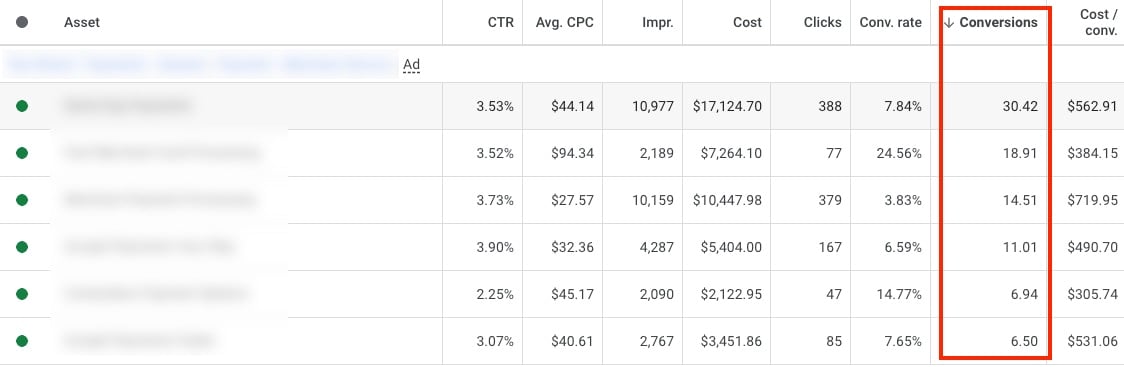 Google Ads now reports click and conversion metrics for each RSA asset. Source: Practical Ecommerce
How to use this data:
- Cut or rewrite low-performing assets. Filter for any headline with 100+ clicks and zero conversions. That’s a headline attracting attention but not the right attention.
- Build clearer asset categories. Now that you can see which types of headlines (offers, brand, social proof, CTA) actually convert, lean into what works and replace what doesn’t.
- Don’t over-react to small samples. A headline that performed poorly might have been tested in less favorable combinations. Give assets enough impressions before making changes.
- Review monthly. Set a recurring schedule. Replace “Low”-rated assets continuously to keep your RSA set fresh and competitive.
Multiple RSAs Per Ad Group
Google’s data shows that advertisers with two RSAs in an ad group see an average 6.6% increase in conversions at similar cost per conversion compared to running a single RSA. Adding a third RSA brings another 3.7% lift.
Create 2–3 RSAs per ad group, each with a distinct messaging theme. Let each accumulate at least 5,000 impressions before evaluating. Check asset-level performance reports to identify which individual headlines and descriptions are pulling their weight.
8 Headline Techniques That Actually Move the Needle
Tactics without context are just tricks. Here are eight techniques with the reasoning behind why they work, when to use each one, and how to execute them within 30 characters.
1. Lead with Your Unique Selling Point
Your USP answers the question every searcher is silently asking: “Why should I click you instead of the other three ads on this page?”
If you offer same-day delivery and your competitors don’t, that goes in the headline. If your product has a lifetime warranty and the category norm is 12 months, say so. “Lifetime Warranty Included” beats “High-Quality Products” because it gives the searcher a concrete reason to choose you.
The key: your USP has to be something your competitors genuinely can’t claim. “Quality Service” is not a USP. “24/7 Live Support — No Bots” might be.
2. Use Action Verbs That Match the User’s Stage
Action verbs push readers toward movement. But the right verb depends on where the user is in their buying journey.
- High intent (ready to buy): Get, Buy, Order, Claim, Start
- Mid intent (comparing options): Compare, Try, Explore, See
- Low intent (just learning): Discover, Learn, Find Out
“Get Your Free Quote Today” works for someone searching “web design agency pricing.” “Discover How SEO Works” is a waste of a headline for someone searching “hire SEO consultant.”
Match the verb to the intent behind the keyword you’re targeting, not to some generic list of recommended verbs.
3. Create Real Urgency (Not Fake Urgency)
Time-sensitive language works because of loss aversion — people feel the pain of missing out more intensely than the pleasure of gaining something. “Sale Ends Tonight” or “Only 3 Spots Left” can significantly boost CTR and conversion rate.
But the urgency has to be real. If your “limited time offer” runs every month, your audience learns to ignore it. Google’s countdown customizer lets you add dynamic countdowns to headlines (e.g., “Sale Ends in {=COUNTDOWN}”) that update automatically as a deadline approaches. This is far more effective than static urgency because it changes with each impression.
The rule: if the urgency isn’t genuine, don’t use it. It erodes trust, and trust is what turns clicks into customers.
4. Name the Pain Before You Offer the Solution
Speaking directly to a problem creates an instant connection. The searcher sees their frustration reflected back at them and feels understood.
“Tired of Overpaying for Software?” works because it validates a real pain point before asking for a click. “Struggling with Slow Shipping?” names the exact frustration that drives someone to search for alternatives.
This technique is especially powerful for lead generation campaigns, where you need to build trust before asking someone to share their contact information. Naming the pain signals that you understand their problem — which makes them more likely to believe you can solve it.
5. Ask a Question That Hits a Nerve
Questions create a cognitive open loop. The reader’s brain wants to resolve the question, which pulls them toward clicking.
The question has to be relevant and specific, not generic. “Want Better Results?” is forgettable. “Spending $5K/Month on Ads with Nothing to Show?” is a punch in the gut for the right audience. “Still Using Spreadsheets for Payroll?” calls out a specific behavior that signals a need for the product you’re selling.
Question headlines tend to work better for awareness and consideration stages. For high-intent transactional queries, a direct benefit or offer headline usually outperforms a question.
6. Put Numbers in Your Headlines
Numbers make claims concrete. “Save Up to 40%” is more believable than “Save Big.” “Trusted by 20,000+ Businesses” is more persuasive than “Trusted by Many.” “Cut Reporting Time by 50%” gives the reader a specific outcome they can visualize.
Odd numbers tend to outperform round numbers in engagement because they feel less manufactured. And specific numbers (“Save 37%”) outperform ranges (“Save 30–40%”) because specificity signals precision.
In a sea of vague headline promises, a number is an anchor. Use it.
7. Tap Into Emotion Without Losing Credibility
Emotional headlines connect because buying decisions are emotional, then rationalized. A headline like “Stop Worrying About Tax Season” touches a real anxiety. “Protect Your Family’s Future” appeals to a deep motivational driver.
The best-performing headlines often combine emotional appeal with a practical benefit. “Sleep Better Tonight — Mattresses Delivered Free” works on both levels. Pure emotional headlines (“Transform Your Life Today!”) without a tangible benefit feel hollow.
For B2B and high-consideration purchases, credibility-forward headlines with an emotional undercurrent outperform pure emotional plays. “Reduce Churn by 30% — Proven Framework” gives the emotional benefit (reduced stress from churn) with the rational justification (30%, proven) in the same line.
8. Choose Clarity Over Cleverness
Inside 30 characters, there’s no room for ambiguity. A headline that clearly states what you offer and why it matters will almost always outperform a clever one that requires the reader to think.
“Easy Online Tax Filing” tells you exactly what happens when you click. “Tax Made Simple” is vague. “Affordable SEO Audits — From $99” is clear. “We Make SEO Work” is not.
Google recommends providing 8–10 unique headlines for each RSA. The more distinct and clear your headlines, the more combinations Google can test and the more queries you can match.
Clarity isn’t boring. Clarity is respect for the reader’s time and attention. In paid search, that respect converts.
Writing Descriptions That Earn the Click
Headlines get the attention. Descriptions close the deal. You get two description fields of 90 characters each — and every character has to pull its weight.
Lead with Benefits, Not Features
Features describe what your product does. Benefits describe what the customer gets. There’s a meaningful difference, and it shows up directly in CTR.
“Cloud-based CRM with API integration” is a feature. “Close More Deals — Manage Every Lead in One Place” is a benefit. The feature tells the reader what the tool is. The benefit tells them why they should care.
Use the “so what” test. For every feature you want to mention, ask: “So what does this mean for the customer?” Keep asking until you hit a meaningful outcome. That outcome is your description copy.
Research from Nielsen Norman Group shows that benefit-focused content generates roughly 30% higher engagement than feature-focused content. In Google Ads, where space is scarce, that gap gets even wider.
Match Your Description to the Headline’s Promise
Your description should extend and support your headline, not repeat it. If your headline says “Free 14-Day Trial — No Credit Card,” your description should reinforce what they’ll experience during those 14 days: “Set up in under 5 minutes. Full access to all features. Cancel anytime.”
If your headline addresses a pain point (“Tired of Slow Shipping?”), your description should deliver the solution: “Most orders arrive in 2 days. Free returns. Real-time tracking included.”
The headline-description pair should feel like one continuous thought, split across two lines for emphasis.
Write Different Descriptions for Different Business Models
Ecommerce and lead generation ads require fundamentally different description strategies.
Ecommerce descriptions lead with price, promotion, and product specifics. Shoppers on Google are comparing. Give them the data they need: “Free Shipping Over $50. 30-Day Returns. 4.8★ Rating.”
Lead gen descriptions do more trust-building. You’re asking someone to share their information before they get anything tangible. Outcome-focused and credibility-forward descriptions work best here: “500+ Companies Scaled Their Revenue. See How We Can Help.”
This distinction matters because the underlying psychology is different. An ecommerce buyer is evaluating a transaction. A lead gen prospect is evaluating a relationship.
Craft CTAs That Tell the User Exactly What Happens Next
A strong call to action removes ambiguity. The user should know precisely what clicking will lead to.
Weak: “Click Here” or “Learn More” Stronger: “Get Your Free Quote in 60 Seconds” Strongest: “Book Your Strategy Call — Pick a Time Now”
Match your CTA to the user’s stage. Top-of-funnel? “See How It Works.” Mid-funnel? “Compare Plans.” Bottom-of-funnel? “Start Your Free Trial — No Card Needed.”
Adding urgency or exclusivity when genuine — “Limited Spots This Month” or “Offer Ends Friday” — can increase conversion rates. But don’t use urgency tactics if they don’t reflect reality. Misleading CTAs get clicks but kill conversions and damage trust.
Aligning Headlines with Keywords and Search Intent
Relevance is the foundation of everything in Google Ads. Your headlines, descriptions, keywords, and landing pages all need to tell the same story. When they do, Quality Score improves, CPC drops, and conversion rates climb. When they don’t, you’re paying more for worse results.
Keyword Placement That Feels Natural
Include your target keyword in at least 3 of your 15 RSA headlines. Google bolds matching terms in the SERP, which increases visual prominence and CTR. But cramming keywords into every headline makes your ad look spammy and reduces the messaging variety Google needs to optimize.
The balance: 3–4 keyword-focused headlines, 11–12 headlines covering benefits, proof, CTAs, and offers. This gives you relevance where it counts and diversity everywhere else.
Dynamic keyword insertion (DKI) is a useful tool for high-volume ad groups with many closely related keywords. The syntax {KeyWord:Default Text} automatically swaps in the user’s actual search term. But DKI has pitfalls — it can produce awkward phrasing (“Need Fix Leaky Faucet Myself?”) or accidentally insert competitor names. Always write a strong default text that works even when the dynamic replacement fails.
Match Headline to Intent Type
Every search query carries an intent signal. Matching your headline to that intent is one of the highest-leverage things you can do.
Informational intent (“how to reduce ad spend”): The user is learning. They’re not ready to buy. Lead with educational value: “5 Ways to Cut Your Ad Spend.”
Commercial intent (“best CRM for small business”): The user is comparing options. Position your product against alternatives: “Top-Rated CRM — Free 14-Day Trial.”
Transactional intent (“buy standing desk online”): The user is ready to purchase. Match that energy: “Standing Desks — Free Shipping Today.”
Navigational intent (“HubSpot login”): The user wants a specific brand or page. If it’s your brand, make sure your ad is present. If it’s a competitor’s, this is a more advanced play with different copy considerations.
When your headline matches the intent behind the query, your Expected CTR goes up, your ad relevance goes up, and your CPC comes down. It’s one of the clearest cause-and-effect relationships in the entire Google Ads system.
Avoid Keyword Stuffing
Stuffing multiple keywords into a single headline — “Buy Cheap Web Design Cheap Website Cheap” — does more harm than good. Google’s system penalizes ads that look spammy, and users won’t click something that reads like it was written by a bot.
One keyword per headline, placed naturally. The rest of your headline real estate should communicate value, not repeat search terms. Google’s AI capabilities and responsive ad format make excessive keyword repetition unnecessary. Write for humans. The algorithm will follow.
Ad Assets (Extensions) That Amplify Your Copy
Your headline and description are the core of your ad, but they’re not the only real estate available to you. Ad assets — formerly called extensions — add extra information, links, and functionality that expand your ad’s footprint on the results page and provide more reasons to click.
Google’s data shows that advertisers using 3 or more ad assets see an average 20% lift in CTR compared to ads without extensions.
The most impactful assets for most advertisers:
- Sitelinks: Add 4–6 links to specific pages on your site (pricing, case studies, contact, specific product categories). Each sitelink can have its own description.
- Callouts: Short phrases (25 characters each) highlighting key selling points: “Free Shipping,” “24/7 Support,” “No Long-Term Contracts.”
- Structured Snippets: Header-plus-list format to showcase service categories, product types, or brands you carry.
- Call Assets: Add a phone number that appears with your ad. Especially valuable for local service businesses.
- Price Assets: Show pricing for your products or services directly in the ad. Helps pre-qualify clicks.
- Lead Form Assets: Let users submit their information directly from the ad without visiting your landing page. Reduces friction for lead gen campaigns.
The key principle: assets should add new information, not repeat what’s already in your headline or description. If your headline says “Free Shipping,” don’t put “Free Shipping” in a callout. Use the callout to say “30-Day Returns” or “No Minimum Order.”
Don’t Forget the Display Path
The display URL path — those two customizable fields of 15 characters each that appear after your domain — is one of the most underused pieces of ad real estate.
Your display path doesn’t have to match your actual URL path. It’s purely cosmetic. Use it to reinforce your keyword and value proposition:
yoursite.com/standing-desks/free-shippingyoursite.com/seo-audit/freeyoursite.com/crm/small-business
These paths give the searcher one more relevance signal before they click. They also give Google one more signal that your ad matches the query. It’s a small thing, but in a competitive auction, small things compound.
Testing and Optimization: The System, Not the Event
The best ad copy in the world is the ad copy you’ve tested and proven works. Intuition gets you a starting point. Data gets you results.
A/B Testing with Campaign Experiments
Google’s Experiments tab lets you create a true A/B test: duplicate a campaign, change only the RSA copy (keep keywords, bids, and audiences identical), and split traffic 50/50. This is the cleanest way to measure headline impact because it isolates the variable.
Rules for clean tests:
- Change one variable at a time. If you’re testing headlines, don’t also change descriptions.
- Track when tests start and end.
- Let tests run for at least 7–10 days to accumulate meaningful data.
- Require statistical significance before declaring a winner. A few hundred impressions isn’t enough.
- Look at all metrics together — impressions, clicks, CTR, conversions, and cost per conversion. A headline that boosts CTR but tanks conversion rate is not a winner.
What to Test
Beyond obvious copy variations, test structural and strategic differences:
- Short vs. long headlines (using all 30 characters vs. keeping it tight)
- Direct benefit vs. question-format headlines
- Urgency-driven vs. evergreen messaging
- Specific numbers vs. general claims (“Save 37%” vs. “Save Big”)
- Feature-forward vs. outcome-forward descriptions
- Different CTA phrasing (“Get a Quote” vs. “See Pricing” vs. “Book a Call”)
Refresh Headlines Before Ad Fatigue Sets In
Headlines lose effectiveness over time. Audiences develop “ad blindness” to messages they’ve seen repeatedly. Plan to refresh your RSA headlines every 2–3 months, even if they’re performing adequately.
Set aside 10–20% of your ad budget for testing new approaches. Each test needs 7–10 days of data. Monitor performance during refresh periods — a temporary dip is normal as Google’s system relearns which combinations work with the new asset pool.
AI in Google Ads Copy: What’s Changed and What It Means
Google’s AI capabilities for ad copy have evolved significantly. Understanding these changes is essential for any advertiser writing Google Ads today.
AI Max and Text Customization
Google’s “automatically created assets” feature has migrated into AI Max for Search campaigns under the name “text customization.” This is a campaign-level setting that generates additional headlines and descriptions using a combination of extractive techniques and generative AI, pulling from your landing page content, existing ad copy, and keyword themes.
Campaigns using text customization, Dynamic Search Ads, and campaign-level broad match will automatically be upgraded to AI Max. This is no longer optional for most advertisers.
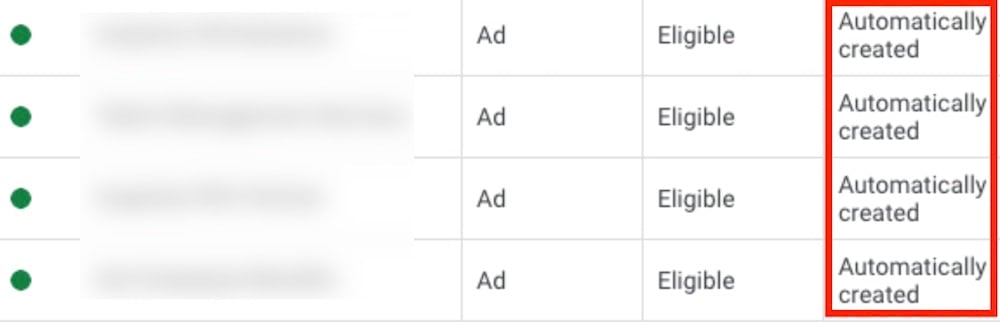 AI Max’s automatic headlines and descriptions can become a source for new or existing RSAs. Source: Practical Ecommerce
What text customization does well: it creates headlines for queries you couldn’t have predicted, filling in coverage gaps in your RSA asset pool. Google’s system checks generated assets for accuracy — it won’t create makeup headlines when your landing page only shows shampoos.
What it doesn’t do: replace strategic, human-written copy. A study analyzing AI-generated vs. human-written RSA performance across a 90-day, $15,000/month campaign found that while AI-generated ads often attracted more impressions at lower CPC, human-written ads significantly outperformed on conversion rate and ROAS. The AI ads brought more clicks, but from users less likely to convert.
The practical approach: use text customization to extend your coverage, but always write your core headlines and descriptions by hand. Human copy provides the strategic foundation. AI fills in the edges.
Text Guidelines: Controlling What AI Writes
Text guidelines let you steer AI-generated copy by defining specific terms to exclude and concepts to avoid.
You can set up to 25 term exclusions and 40 messaging restrictions per campaign. For example: “Don’t use the word ‘cheap'” or “Never reference competitor brands” or “Always include ‘licensed and insured’ in generated text.”
For advertisers in regulated industries — healthcare, financial services, legal — text guidelines are essential. But even for standard ecommerce or SaaS campaigns, setting basic guardrails prevents the AI from generating off-brand messaging.
If you’re using text customization (and soon most advertisers will be), configuring text guidelines is not optional. Without them, the AI operates without brand constraints.
Dynamic Keyword Insertion and Countdown Customizers
DKI ({KeyWord:Default Text}) remains a useful tool for automatically matching ad copy to search queries. The recommended approach:
- Choose proper capitalization (Title Case is standard for headlines)
- Write a strong default that works when the keyword doesn’t fit
- Don’t combine DKI with broad match keywords — the inserted terms can be irrelevant
- Never insert competitor brand names through DKI
Countdown customizers add real-time urgency that updates with each impression. They’re more effective than static “Sale Ends Soon” copy because the specificity makes the urgency tangible.
First-Party Data and Personalization
First-party data — information collected directly from your customers with their consent — has become increasingly valuable as third-party cookies phase out. About 90% of consumers are willing to share personal information in exchange for better experiences, and marketers who use first-party data effectively can double incremental revenue from single ad placements.
In Google Ads, you can upload customer lists, email lists, CRM data, and past purchase behavior for audience targeting in Performance Max and other campaign types. This allows you to write ads tailored to specific audience segments:
- Existing customers: Cross-sell with product-specific messaging
- Lapsed leads: Re-engage with updated offers or new features
- Website visitors who didn’t convert: Address likely objections in your ad copy
- High-value customer lookalikes: Lead with the messaging that converted your best customers
The more granular your audience segmentation, the more precisely you can tailor your headlines and descriptions to match what each group actually cares about.
Common Mistakes That Kill Ad Performance
Knowing what to do matters. Knowing what to stop doing matters just as much.
Writing 15 headlines that all say the same thing. If your headlines are “Quality Web Design,” “Professional Web Design,” “Expert Web Design,” and “Best Web Design” — Google has nothing to test. Diversify across the five headline categories: keyword, benefit, proof, CTA, and offer.
Ignoring the landing page. A high CTR with a low conversion rate almost always points to a disconnect between what the ad promises and what the landing page delivers. Audit this connection regularly.
Over-pinning RSA headlines. Every pin reduces Google’s optimization space. Pin only when you have a legally or strategically necessary reason.
Using generic CTAs. “Click Here” tells the user nothing. “Get Your Custom Quote in 60 Seconds” tells them exactly what to expect.
Stuffing keywords. One keyword per headline, placed naturally. Let the rest of your headlines do different jobs.
Never refreshing ad copy. Even winning headlines lose effectiveness after 2–3 months. Schedule regular refreshes.
Treating AI-generated copy as final copy. Google’s text customization is a starting point, not a strategy. Human-written copy consistently outperforms on conversion rate and audience quality.
Ignoring ad assets. Running ads without sitelinks, callouts, and structured snippets is leaving CTR on the table. Ads with 3+ extensions average 20% higher CTR.
Writing the same copy for ecommerce and lead gen. Ecommerce copy leads with price, shipping, and product details. Lead gen copy leads with outcomes, credibility, and trust signals. They require different approaches.
Not using per-asset performance data. Now that Google shows click and conversion metrics for individual headlines, there’s no excuse for running underperforming assets indefinitely. Review monthly. Cut what doesn’t convert. Test new angles.
Putting It All Together
Writing high-converting Google Ads is a system, not a one-time creative exercise. Here’s the workflow that top advertisers follow:
1. Start with intent. Before writing a single headline, understand the search intent behind your target keywords. Informational, commercial, or transactional intent each demand different messaging approaches.
2. Write across all five headline categories. Keyword, benefit, proof, CTA, and offer. Fill all 15 headline slots. Fill all 4 description slots. Give Google enough variety to optimize.
3. Pin sparingly. Pin your primary keyword headline to Position 1. Leave the rest open.
4. Set up ad assets. Sitelinks, callouts, structured snippets, and any other relevant assets. Each one expands your ad’s footprint and improves CTR.
5. Align your landing page. The headline promise, description details, and landing page H1 should feel like one continuous conversation.
6. Configure text guidelines. If text customization is active, set your term exclusions and messaging restrictions.
7. Launch and wait for data. Give each RSA at least 5,000 impressions before evaluating.
8. Review per-asset data monthly. Cut low-performing headlines. Replace them with new variations that test different angles.
9. Run structured A/B tests. Use Campaign Experiments with a 50/50 split to isolate headline impact from other variables.
10. Refresh every 2–3 months. Even strong performers develop ad fatigue. Keep your copy fresh to stay ahead of declining engagement.
The Google Ads landscape changes constantly — new AI features, new RSA behaviors, evolving auction dynamics. But the fundamentals of great ad copy remain stable: match intent, communicate value clearly, give the reader a specific reason to click you instead of anyone else, and deliver on the promise when they land on your page. Everything else is optimization at the margin.
The advertisers who win are the ones who treat ad copy as a discipline, not an afterthought.